For 50 years, antibiotics, vaccines and oil have taken us out of our natural condition, yet they have also taken away our awareness of the materiality of our existence. The coronavirus pandemic and global warming are part of a ‘stunning return of reality’ that requires us to rethink our relationship with the environment.
In an article published in the New York Times on 18 April 1999, Italian semiologist Umberto Eco made note of the measure of the extraordinary quality of his time: if you were sick, you could take antibiotics for a week to recover; if you were cold, all you had to do was turn up the radiator to feel warm; and when you were hungry, you could take your car to drive to the supermarket. Because all of this was different before the 1950s. From the beginning of mankind up until then, there had been a 50-50 chance of surviving, if you caught a viral or bacterial disease. We felt the deadly cold every winter and the periods of dearth before the arrival of spring. In Umberto Eco’s eyes, newly invented antibiotics spreading after the Second World War, compulsory vaccinations beginning simultaneously, and oil, boosting agricultural production, were to be taken advantage of to sustain a humanity that would increase its numbers exponentially and double its life expectancy.

Thanks to antibiotics, vaccines and oil, humanity had triumphed over its animal fate, largely extracted itself from its fragile natural condition and heralded the start of a new era – one that the philosopher Jean-François Lyotard described as ‘postmodern’, in which human sciences triumphed over natural sciences, social interpretations over certainties of nature and subjectivity over objectivity.
This explosion of human power over the Earth and its bodies, and the consequent transformation of our environment – first in our favour and now to our disadvantage due to pollution and global warming – has a very short history, in the order of 50 years, a drop in the ocean of human history, which began thousands of years ago, and which until then was largely made up of hunger, coldness and disease. Today, however, in the face of global warming and the coronavirus pandemic, this extraordinary period of human history seems to be behind us.
In recent years, the postmodern philosophy born in the 1950s has also taken a serious turn for the worse. In ‘Why Has Critique Run Out of Steam’, a seminal article published in the University of Chicago’s Critical Inquiry in 2004, philosopher Bruno Latour already questioned the validity of the Nietzschean creed that underlies postmodern thinking: ‘There are no facts, there are only interpretations.’ This was the breeding ground for climate sceptics, who questioned scientific facts and sought interpretations other than anthropogenic CO2 emissions to explain global warming. More fundamentally, Bruno Latour questioned the denial of the dominant French thinking at the time, that of the structuralists, to attribute a share of responsibility in the unfolding of human history to the non-human (mainly to the climate and disease). Refusing that mankind can modify the climate and refusing that the climate can modify human history was not merely the point of view of a few marginal conspirators.
Today, a new moment in philosophy is unfolding and moving away from postmodern relativism. In the 1980s, a great structuralist historian Emmanuel Le Roy Ladurie denied that the climate had any real interference in human history and mocked his English colleague Hubert Horace Lamb who, at the same time, predicted the phenomenon of global warming with exceptional accuracy. According to the English researcher, the Hundred Years’ War, which regularly saw the English invade France and particularly Bordeaux, was due to the rise of the Little Ice Age which, from the 14th century onwards, had made it impossible to cultivate vines in England, forcing the Englishmen to conquer the Bordeaux region in vital search of wine (tainted soft drinks at the time). Following in the footsteps of Lamb, the American historian Jared Diamond marks the end of the anthropocentric structuralist vision of human history by declaring viruses and animals primordial actors.
Another contemporary philosophical moment is unfolding under the terms of ‘realism’ or ‘new realism’, moving away from postmodern relativism, from the culturalist deciphering of structuralism, which no longer seeks to understand the causes of human facts but only their social meanings. Maurizio Ferraris in Italy, Markus Gabriel in Germany, Jocelyn Benoist in France – each one measures the existence of things outside of human consciousness, and in a certain way reintroduces the importance of the non-human constituents into philosophy, our lives and, more generally, our Earth.
It rains, whether we are there or not. It is cold in winter, whether we like it or not. The change is what is important and the radicality of this thought is already beginning to emerge in the United States, where historians such as Timothy J LeCain note that 80% of the cells making up the human body are not human – they are those of bacteria that populate us – and reverses the hierarchies by describing the human being as a simple means of locomotion for microbes.
This provocative thought, however extreme it may be, is nevertheless necessary in today’s debate, reanimating and renewing our human-centric thinking in the face of the current challenges of global warming and the revealing episode of the coronavirus pandemic. What are these two phenomena for, if not a staggering return to reality? I would even go as far as to say that this is only a return to normal. We have indeed lived through a very short time where antibiotics, vaccines and oil have exceptionally taken us out of our natural condition. Contrary to some who blame modernity, and even more so the Enlightenment, for the current disaster, I believe that modernity and technology have nothing to do with it. For 50 years, they have allowed us to live longer and to save our sick children from death, they have given us food and enabled us to get through the winter.
The coming catastrophe is not new. It has been the daily life of human beings since the dawn of time, with the exception of the past 50 years.
It should be quickly recalled here that the Enlightenment and the modernists, from the 18th century to the 1950s, did not know about antibiotics, that life expectancy was still 40 years at the beginning of the 20th century and that, as late as 1930, an architect like Le Corbusier only proposed to raze the overcrowded and so-called insalubrious districts of Paris in order to prevent the spread of cholera and tuberculosis, which at the time could not be cured. And for those who might have some doubts about the possible beauty of the hard times before the 1950s, it should be remembered that Villa Rotonda, Andrea Palladio’s masterpiece, built in the 16th century in the Veneto region, owes its shape only to climatic principles: the summer heat, the evacuation of hot air through its dome and the shading of its rooms through its porticoes.
For human is a naked ape who survives only thanks to technology, thanks first of all to fire, which has warmed us in winter and has made it possible to inhabit the planet’s naturally uninhabitable climates; the fire that has externalised the energy, the generation of which exhausted us during digestion by allowing us to cook food. Technology has given us clothing, tools, shelter and has allowed us to live on the Earth. Today, it is thanks to technology of modern medicine that 15% of serious cases of coronavirus are saved by being put on respiratory assistance in hospitals. The coming catastrophe is not new…It has been the daily life of human beings since the dawn of time, with the exception of our last 50 years.
More than modernity, I believe it is postmodernity that is not responsible for the current crisis, but has taken away our awareness of the materiality of our existence, has removed our natural burden in favour of a single cultural burden and with it our means of acting in a world that will always remain as non-human as ever. I do not know exactly how this ‘realistic’ shift will translate into other fields, but I do know how it is already being translated into urban planning and architecture. And it is by no means reactionary, but on the contrary opens up new fields of emancipation, freedom, imagination and is a tremendous opportunity for a new social contract both among humans and with non-humans.
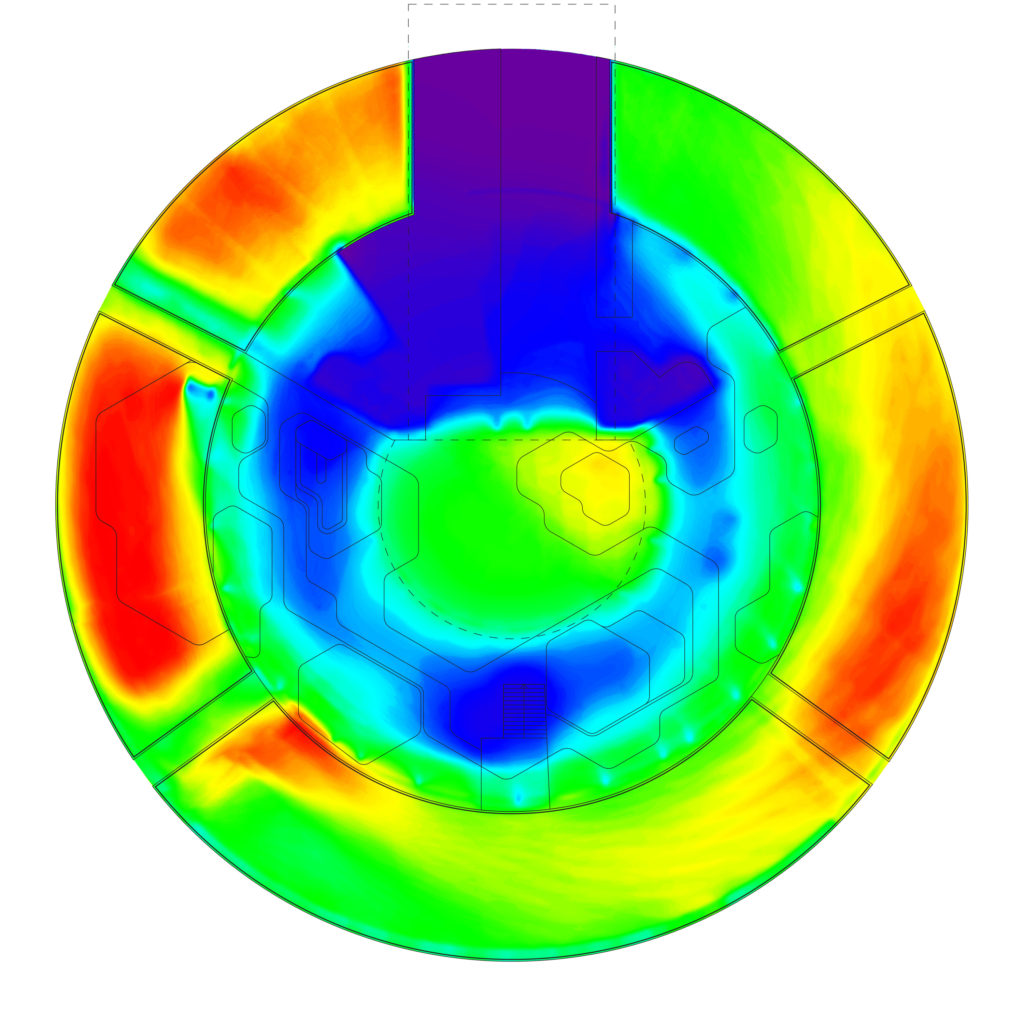
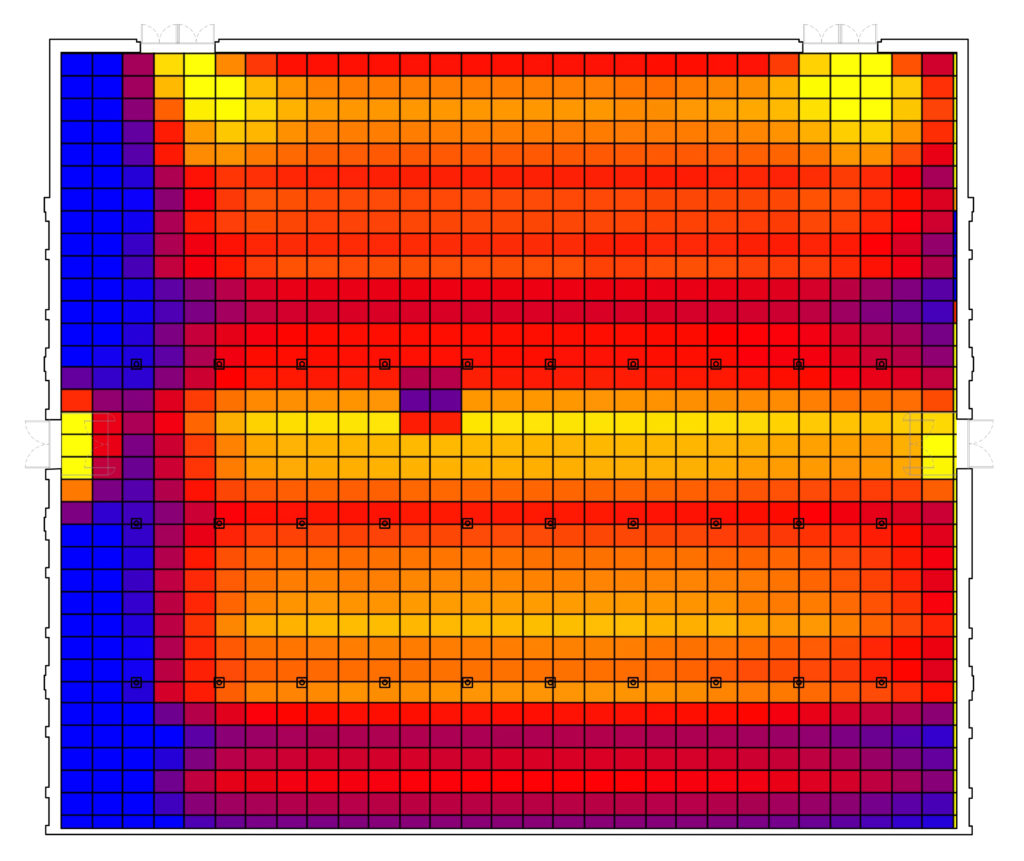
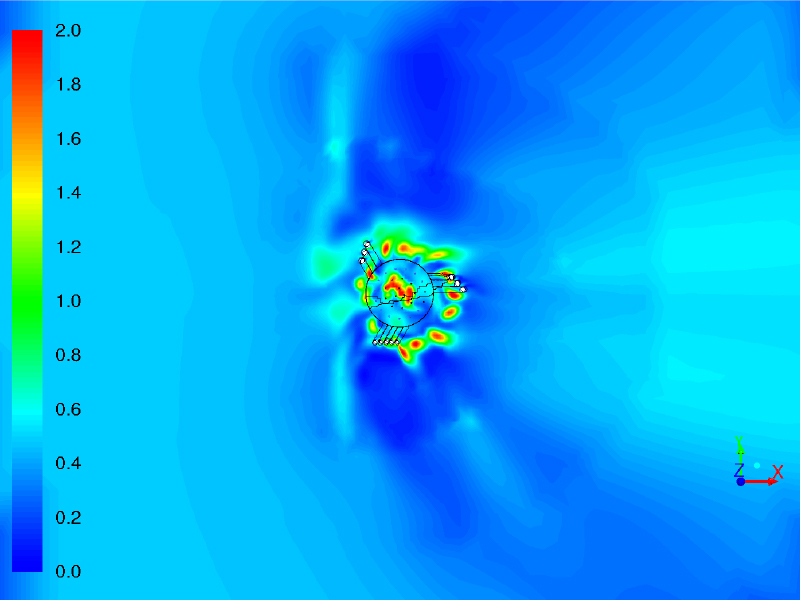
When we no longer speak of a square in town but of an ‘island of urban freshness’, when we no longer speak of a perspective pointing at a statue of Louis XIV but of an urban breeze to refresh and evacuate air pollution with fine particles, when we no longer speak of the colour of a building from a cultural point of view (red means firemen, black means rock ‘n’ roll, to put it simply) but of albedo, when we no longer design apartment plans according to private-public principles but according to air humidity levels and atmospheric convection movements, when we design a building façade no longer for prestige and its meaning but to thermally insulate the interior from the exterior and thus reduce the energy consumed, all this is really just a return to normal.
Philippe Rahm is a Swiss architect, principal in the office of Philippe Rahm architectes, based in Paris, France. His work, which extends the field of architecture from the physiological to the meteorological, has received an international audience in the context of sustainability. His recent work includes the first prize for the Farini competition (60 ha) in Milan in 2019, the 70 hectares Central Park in Taichung, Taiwan, completed in December 2020, the Agora of the French National Radio in Paris, a 2700 m2 Exhibition architecture for Luma Foundation in Arles, France. He has held professorships at GSD Harvard University, Columbia, Cornell or Princeton Universities. He is a tenured associate professor at the National Superior School of Architecture in Versailles, France (ENSA-V). His work has been exhibited in 2017 at the Chicago and Seoul Architecture Biennales.
This text was first published in French on 10 March 2020 by the French daily news website AOC. https://aoc.media/opinion/2020/03/09/coronavirus-ou-le-retour-a-la-normale/