Architecture is not just for humans. It creates environments for beings of many different sizes. We get joy and comfort from sharing spaces with partners, friends, pets and houseplants. But even when it might look like we are on our own, we can rest assured that we are not: a building can house trillions of microorganisms interacting with each other, with humans and with their environment.1 They live on our walls, counters and shower curtains. They come in through open windows, fall off our bodies, float on our breath, grow with our houseplants and help us make bread. The air around us is never unpopulated. Even though the modernists might have tried to make it so – in Corbusier’s dream ‘there are no more dirty, dark corners. Everything is shown as it is. Then comes inner cleanliness…’. Architecture cannot and should not try to eradicate nature, but instead make space for cohabitation between humans and non-humans; to make space for diverse ecologies.
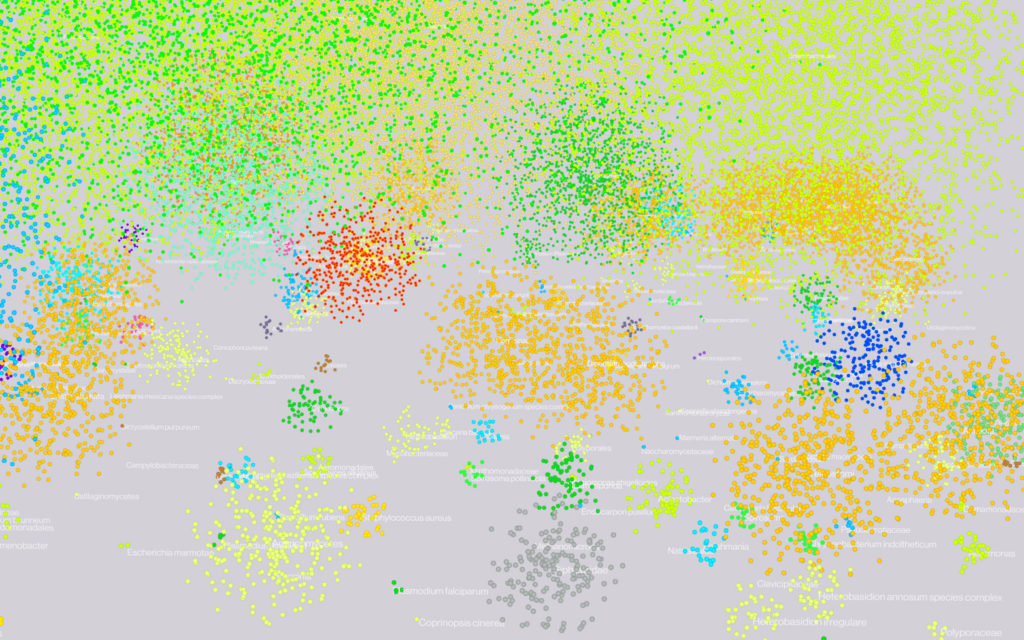
Metagenomics allows us to meet our microscopic cohabitants. Also referred to as environmental genomics, this field of study looks to characterise genetic material recovered directly from a particular setting. As DNA sequencing is becoming more and more economical and accessible, we are starting to get a much clearer picture of how microorganisms interact in their home environments, from the human gut to the forest floor and London air. Dr Darren Chooneea, a research scientist at the Natural History Museum, has been sequencing DNA captured from air samples and believes that characterising it can tell us many things about the urban environment. ‘For example, it can tell us what organisms are in an area, whether new organisms are moving into an area, or if certain organisms are disappearing,’ he says. We also get to see that the air is a space of biodiversity; when we breathe in, we don’t just inhale particulate matter, pollen or pollutants, but microorganisms too. And the way we design our buildings and cities determines which microorganisms we inhale.

At the same time, the people inhabiting space are more microbe than human. Microbes are so prevalent in and around the human body that they outnumber human cells and have profound effects on how we function, feel and think. Animals, plants and humans have co-evolved in and with environments that are rich with microbes. Metagenomics shows that oftentimes, we design architecture not as a bridge between humans and microbial diversity, but as a barrier.2 In poorly-ventilated interiors we tend to find microbial communities that are less diverse and with higher concentrations of pathogens than in green spaces.3 We all intuitively know that time spent in nature makes us feel better, but metagenomics also shows us why and gives us the tools to demand fair access to our microbial ‘old friends’4. Our lives are tied to the microbiome – the coronavirus has shown this very clearly, so I believe that now is the time to start imagining architecture as a space we cohabitate with microbes in a dynamic based on care, not on fear.
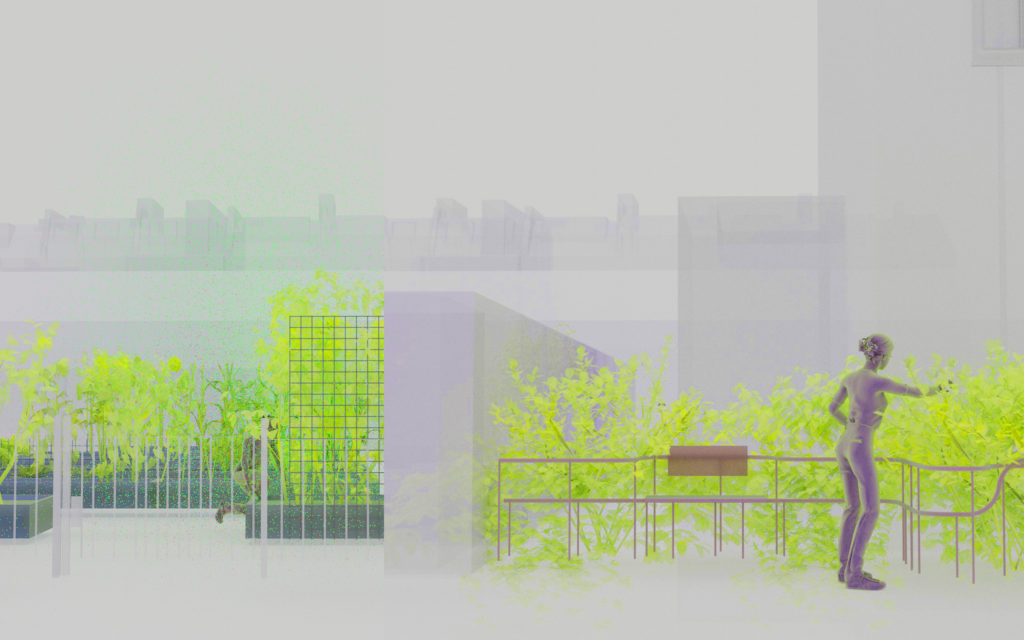
In Anna Lowenhaupt Tsing’s words, ‘Making worlds is not limited to humans – all organisms make ecological living places, altering earth, air and water…Each organism changes everyone’s world.’ We sit alongside other critters in ever-changing configurations of places, times, matters and meanings. So if we finally start treating the built environment as an environment, we start valuing what ecologists have long been arguing for: diversity, resilience, flexibility and adaptation.
1 Steven W Kembel et al, ‘Architectural design influences the diversity and structure of the built environment microbiome’, in The ISME Journal 6, 1469–1479, 2012. https://doi.org/10.1038/ismej.2011.211
2 Anirudra Parajuli et al, ‘Urbanization Reduces Transfer of Diverse Environmental Microbiota Indoors’, in Frontiers in Microbiology, vol. 9, 2018. https://doi.org/10.3389/fmicb.2018.00084
3 Steven W Kembel et al, ‘Architectural design influences the diversity and structure of the built environment microbiome’, in The ISME Journal 6, 1469–1479, 2012. https://doi.org/10.1038/ismej.2011.211
4 Jake M Robinson and Anna Jorgensen, ‘Rekindling old friendships in new landscapes: The environment–microbiome–health axis in the realms of landscape research’, in People and Nature, vol. 2, no 2, 2020, pp 339-49. https://doi.org/10.1002/pan3.10082
Ioana Man is a designer and researcher working between architecture, strategic design and critical practice. Since graduating from the Architectural Association, she has been developing tools, experiences and multimedia narratives that highlight both the importance of microbial biodiversity in the built environment and the necessity of distributing its benefits fairly. She is a Designer in Residence for 2020–21 at the Design Museum London, and design lead at Faber Futures.